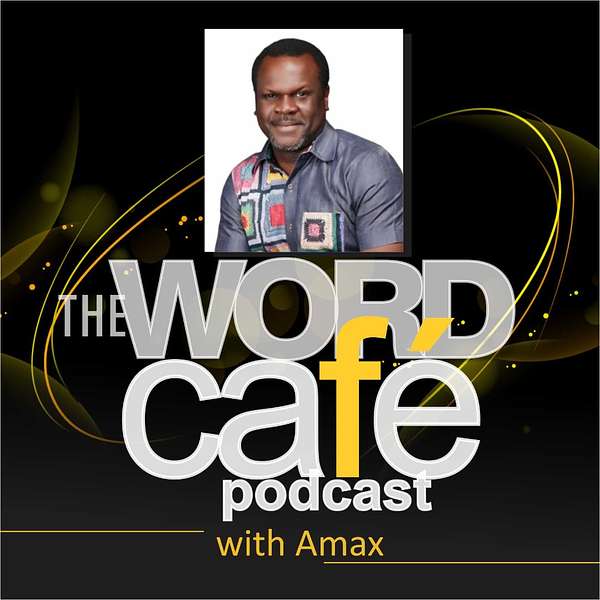
The Word Café Podcast with Amax
My unique message to the world is the power behind the words of our mouths. We have made light of it but cannot escape the fruits thereof. For me, words are the unit of creation, the building block on which our existence evolves. This podcast is for everyone who wants to better their living by using words and applying themselves wisely. I will be using the storytelling style fused with imaginative nuances to transport the listener to that place, where possibilities are not luxuries but everyday experiences; movie in voice.
This podcast will emphasize the power of routine, and what you repeatedly do, you most likely build capacity and expertise for what you repeatedly do. My podcast will help the listener learn how to practice success because the same amount of time you use in complaining is the same you can use to plant, build, prune, etc. I intend to draw the listener's attention to the power of their words.
The Word Café Podcast with Amax
S4 Ep. 264 Economic Chessboard Of Nigeria
Strategy comes alive when the economy is viewed like a chessboard. We reframe Nigeria’s markets across 64 squares, where each square represents an industry and each piece mirrors a real actor: kings as policy institutions, queens as visionary industrialists, rooks as powerful conglomerates, bishops as diagonal innovators, knights as agile dealmakers, and pawns as the countless SMEs pushing toward promotion. What looks like a flat board hides a layered terrain of liquidity, regulation, and technology—tilts that speed up some moves and slow others.
We unpack how colonial openings constrained the early game and how today’s middle game is defined by consolidation, alliances, and vertical integration across cement, energy, finance, logistics, and telecoms. From diversification to innovation leaps, we explore the tactics that build durable advantage in Nigeria’s economy: strategic castling through public–private partnerships, surviving regulatory ambushes like sudden forex or tax changes, and the long march of promotion as startups scale into regional leaders. We highlight the role of industrialists who move like queens across multiple files, the steady influence of rooks in pan-African institutions, and the surprising jumps of knights who time entries and exits for outsized impact.
At the center of this story are SMEs—the pawns whose disciplined grind unlocks transformation. With patient play, access to capital, and smart policy, the smallest pieces can reshape entire files. We close with practical takeaways: choose the right square, understand your piece, read the gradients beneath your market, and plan three moves ahead. If you’re a founder, policymaker, or operator, this lens helps you make clearer decisions, build resilient strategies, and spot new diagonals of growth.
Enjoy the episode, then share it with someone who’s ready to rethink their playbook. Follow our channels, subscribe for fresh drops, and leave a review to tell us which move you’re making next.
You can support this show via the link below;
https://www.buzzsprout.com/1718587/supporters/new
Hello there. Welcome to the World Cafe Podcast. This podcast has been designed. We created content that centers on the power of words. Can we really do anything without speaking? Can we really do anything without the agency of words? Yes, that is what this podcast is all about. And I am your host, Amakri Iswe, your neighborhood word trader. I believe in the power of words, for it is the unit of creation. I trade in words to profit my world. So I heard this sound some time ago done by T.Y. Bello.
SPEAKER_00:Closer than closer than close. Closer than closer than close. Closer than closer than close. To me.
SPEAKER_01:Don't worry. It's not about singing today. Good morning. Good afternoon. Good evening. Good everything. How are you? How are you? I'm fine. Yep, welcome to the World Cafe Live Show. I did that song because it's been with me for a while. Humming it and all of that. The closeness of God, you know, He it reveals a lot when you know how close God is to you. And that's not the conversation for today. Yes, you're seeing something in front of you, the chessboard. I had to do that song because sometimes, not sometimes, all the time for me, my inspiration comes from God. And He points me to things and I dwell on it for a while. I learn from it and I come to share. I know we've had this chess conversation on the show before, but that's not what we're going to do today. And we did a lot about that. And I want to use the chess to explain something that came to me. I call this episode the economic chess board from my country, Nigeria. Yeah, a good number of us who have come across the chess game. It's quite uh thought-provoking. You see it. You have 64 spots on the board. Alpha numeric. One part of it you have numbers, and the other you have uh what do you call alphabets? I from my own thinking is the value system of the world is alpha numeric. When you look at the earth, the value is alphanumeric, and you have pieces on the board and all of that. You know, you have the the the castle, you know, what do you call it? Is it yeah, the castle? You have the the knight or the rook as the case may be, you have the bishop, you have the queen, the king, the queen, you have, you know, and all of that. We've gone through all of that, but I want to use that to explain what came to me, and I wrote about it. I call it the economic chessboard. Is it the chessboard? 64 squares still remains, but each square represents an economic sector or industry. Follow my thought. For example, banking, oil and gas, cement, telecoms, agriculture, fintech, infrastructure, power, creative economy. These are spaces. Imagine all the boxes there. And if you look at our society, our world, our country, as a people, this is what we see play out. You know, so the board is not just flat. You know, you look at it, it's flat, but it's not just flat. There are layers of capital that sit beneath each square, symbolizing how liquidity, policy, and innovation feed industries differently. Yeah, you're seeing it like a flat board, but no, underneath the supposed uh flatness, there's a three-dimension to it. You're seeing the two dimensions now, but beneath it, there's a three-dimension to it, you know. So now let us look at the pieces. We're going to start with the actors. I call it the economic actors, kings. They move slowly, but are the ultimate guardians. When they collapse, the entire economy game ends. Their survival matters more than their dynamism. You see? You see that now? Yeah, survival. In Nigerian's context, the federal government, the CBN, and the regulatory institutions, they are the kingmakers, they are the kings. I beg your pardon. You know, come up with the policies and all of that. Yep. Then the queens, visionary industrialists like Dangote, Ilumelu, Tedola, Rabiu, Adenuga. So I'm using this to talk about the economic landscape of Nigeria. It's for learning purposes, anyway, to stimulate our minds for us to see, you know. So they move across the board, you know, like the queen, they move across the board with the most power, representing influence across multiple industries. You know, when you look at the chessboard, the queen can move in any direction. Yeah, but the the king moves just like we explained slowly, but that you know, uh they are the ultimate guardians. So you see that, for example, now Dangote is mental sugar, oil, and refinery. UBA, power, you know, transcop and uh entrepreneurship, the Ilmelu uh foundation. So their strength lies in diversification and reach, much like the queen. Yes, that's the strength. Lies in you know, you know, when we we started hearing the name Ilmelu in Nigeria, it was in banking, if you remember, in banking, but today that name has moved on even into power, the power sector has moved on even into the oil and gas. When you talk about power, the transcop power, yes, then you talk about the oil and gas as holding. Yeah, then let us look at the the rook's conglomerates and institutions, strong, long-range moves. You know the way the rook moves on the chessboard, they represent B corporations and pan-African institutions, like Dangote Group, the UBA group, the MTN, African Bank. You see, that's what we see on the on the I mean, we see they move straight, signifying structure, sector-wide dominance, like the rook moves on the board. Straight, you know the rook, what we call the castle or the rook. So that's what they represent. Then the bishops, innovators, and strategic investors. Yes, this piece. That's what they look like. The bishops, they move diagonally, representing unconventional angles of wealth being created and at the same time being disrupted. So unconventional diagonal moves. Example of those are fintech, the fintech founders like Paystack, Flutterwave, and new green energy players. They are really not following, quote unquote, the supposed established rules, they are disruptors, they come to disrupt the market, the bishops. Then the ninth, they are the deal makers and opportunists, they move in L shape, symbolizing agility, surprise, and leverage. That's how they move. These are entrepreneurs like Oteola, strategic entry, exit. In you know what happened in Fort Oil for those of us who were following the Fort Oil, the way he entered and exited, I mean, exited, I beg your pardon, you know, then the Girigu power or venture capitalists who thrive on timing, so they observe the bishops, observe, you know, and all of that. They don't move linearly but leap over obstacles. In other way, uh, what do you call the knights move? Three steps the L shape, L shape. So they can jump. Yes, these are what we have. Then the pawns, SMEs, startups, and grassroots entrepreneurs, they are very numerous, but they are vulnerable, they advance slowly. When they reach the opposite side, they can transform, mirroring how African SMEs can scale into global firms if they survive. Yes, you know what the pawns are, they are the dispensable pieces on the board, but the more they travel, you know. I've talked about that the travel, I mean the journey of the pawn on the chessboard, the more they travel and they get to the other end of the board, they are more or less like promoted, they are elevated, you know. So they were small, despite not the days of little beginnings, but they have grown, and now they are also deal makers and what have you. Yep. So let us look at it now. The moves, so the opening, you know. Let's start, let's just explain something. Colonial legacy and extractive economies. The first moves are heavily constrained, like starting from inherited colonial structures. The pawns represent early indigenous entrepreneurs pushing forward against imported dominance. It's self-explanatory. The middle game consolidation and morganization. I know I've talked about Morganization on this show before. For those of you who are following or who've been following, you know, JP Morgan. You've heard about JP Morgan, one of the strongest banks in the world. Yes, in the US, he started something, he's he was a man, JP Morgan. He started something, he moved Wall Street from Pennsylvania to New York. Yep, he did that, came up with so many banking, would I say uh laws, policies in the US. So now let us look at the middleman, consolidation and organization. Just like JP Morgan consolidated railroads and steel, the railroads of America and the steel needed money. JP Morgan came up with a structure, he consolidated, bringing them together, like for them to communicate. So African industrialists are consolidating key industries. For example, Dangote organizes cement and now oil. Ilumelu organizes banking and power is consolidating. The game becomes about building alliances, controlling entire fields and entire files and diagonals. You understand what that means on the chessboard, industries and regions, you're networking them, bringing them together, neutralizing rivals through measures and acquisitions. Alright then. End game. So imagine taking up those uh what I call a trade barriers. It means each of the squares can communicate with themselves, you know, easily. All right, special. All right, let us look at it. Some rules, some rules on the chess board that we can translate. There's what is called castling strategic alliances example Dangote partnering with state governments or Ilumilu working with global institutions like IFC and Passant. It's a it's a kind of rule uh on the chessboard, regulatory ambush, sudden government policies, forex, uh, forex bans, fuel subsidy removals, new tax regime that capture players unexpectedly. These are, you know, then promotion, SMEs to conglomerate. I talked about them earlier, where pawns that reach the last rank symbolize African entrepreneurs whose scale, for example, Pay Stack, reaching global relevance with Stripe. You heard about it when Stripe came for PayStack, and you know there was this collaboration, more or less like uh PayStack has grown across the chessboard, her journey to the other end, creating a unique entity. Now, victory conditions. Okay, let us look at this victory conditions. Uh not just checkmate. If you want to win, you checkmate and all that, but this is beyond that. Victory is sustainable economic dominance and societal impact. You see, a player may win by one number one, monopoly or consolidation, owning an entire industry, just like what we see with that. I mean with Dangote, cement and refinery, owning an entire you know, diversification, spreading across multiple sectors, just like what Elumelu did, finance, power, and hospitality, yeah, innovation leap, disrupting incumbents, like what Flutter Wave did, and Junior, you know, the e-commerce thing, then policy influence, aligning with the king, yes, governments to secure long-term dominance. So this the chess game becomes a mirror of Africa's economy, particularly Nigeria, where names like Dangote, Elumelu, or Tedola, and the others play as queens, rooks, and bishops and knights in a grand dance of consolidation, innovation, and survival. The JP Morgan Morganization parallels show up in how they organize chaos interstructure, capturing not just squares on a board, but entire industries in Africa. So the you know that's one thing about chess. It helps you think strategy, it helps you think uh, it broadens your horizon. It's not just a game for entertainment, it's a game that teaches you so much. Yep, economics, politics, strategy, war games, and all of that. And I I mean when it came to me, I felt like okay, when I worked on this, I said I'm going to uh bring it and uh share it with my with you, my audience, to know that you can learn a lot and there are so much opportunities. Don't forget how all of this started in terms of the economics for our country from the colonial, so the smaller entities who went into the game and started to grow, and here they are today. Someone will ask, so what do you expect of me? Play more chess, maybe engage your mind more, maybe in the economic landscape of your country, our country. Yeah, you can be part of it, you can be part of it. That's the truth. That is what the chess game teaches you, like the pawn, quite insignificant, but her journey on the board. If you take your time to study her journey on the board, she ends up, or he ends up becoming the king or even the queen, as the case may be. Alright, guys. Uh that's what I came to do on the show today, just to share this with you, uh, to stimulate your mind, for you to think, for you to like really think, engage your mind. Why are things not working the way I want them to work? It could be you're not looking in that direction. Yep. It could be you're not moving in the right, what I call it, square on the chess board. It could be you're moving in. The wrong direction. Or it could be you're not even doing anything, you're just there complaining. But this will help you. Are you a business person? Whatever you are into, this will help you. Policymaker, this will help you. For your information, life is not a game, but gamification will help you. I know certain organizations that are bringing gamification into their activities. You know, it seems like you are entertaining yourself, it seems like you're playing, it's it seems like you're more or less like quote unquote joking, but actually you're learning. You are learning, you're bringing things into reality and tangibility, and that is what we came to do on the show today. Well, I'm not a chess fan, per se, but I love observing. And when I observe things, I learn from it, and from that I come on the show and I share with you. You know, so everything around me teaches me everything, everything. It calls my attention, and I give it a look and I say, Okay, this is what you're telling me. Okay, this is how you want me to put it. Okay, fine, I'm going out there, I'm gonna put it out there. Parents, I want to encourage if you're a parent, mother, father, a school, encourage the children to play games. Yes, games like chess, monopoly, scrabble, uh, jenga. Why? Because it helps with this. Yes, your brain power, your mind. You know, it helps fuel your mind. It resources, it resources, I beg your pardon, the mind with techniques, with strategy, with moves, it expands it to, I mean, that horizon, it takes away the blocks or the blockade and the blockages. I beg your pardon. It takes all of that away, and you're seeing possibilities. Ah, yes, that's what it does. Gamification helps you see possibilities, it makes you think, it makes you ask the right questions, it makes you unpack and repack. It even helps you to destroy things in a good sense, like you pull it down in the from the point of disruption, and you begin to gradually build them up. It teaches resilience, it teaches patience, it teaches uh strategic moves. If you have a child who is restless, bring a game, it will teach, all right, guys. You know how we say it on the show. This is the space where we come in to lean on one and others experience to what forge a positive path, and this is what we've came to want to show today the economic chessboard in Nigeria. Pay attention, pay attention. We are all in that game, all of us, consciously and unconsciously, from our subconscious. All right, then I need to go, I need to go get ready again. Yes, yes, yes. I'm going to bring some fresh inspiration, fresh observation, and take you to that level. Alright, then gotta go now. Are you following us? Please do. We're available on LinkedIn, on X, on where Instagram, and we have a YouTube channel, even on Facebook. Yes, we're there. We have a YouTube channel. The name of the channel is Amakri Isouwe. That's it. Yep, look for us and you will find us. Are you following? Please do hit that notification button so that you'll be the first to know when things like this, yes, episodes like this drop. Are you view? Please do, and again, I say share, share with your friends, share with your family, share. There's a lot we can learn, you know. When we share, it increases. When we share, it increases. When we share, it increases. It doesn't reduce, it increases because there's love in sharing. All right, then I have to run down till I come your way again. You know how I say it. My name is Abakri. Abakri is away.
unknown:Bye for now.
SPEAKER_01:Awesome time it has been with you on the World Cafe Podcast today. Thank you for being there. You can catch me up on my social media handles: Twitter, Facebook, LinkedIn, and Instagram, all at Amakri Isoboye. Also, you can get copies of my books at Cocktail of Words, The Color of Words, by HRO Notebook, and Hoker's Focus on God on Amazon and Roven Heights online bookstores. You can also subscribe to my YouTube channel at the same address at Amakri Isobaye. I love to hear from you and how this podcast has impacted you. You can leave me a message at my email address, amakrigaribaldi at gmail.com. That is A M A C H R E E G A R I B A L D I. Yes, till I come your way again. Bye for now.